Illegible leadership.
Will the people who got you here take you where you need to be?

Will the people who got you here take you where you need to be?
That question has come up in two different ways in recent CEO conversations.
The first concerns someone who joined as a strong individual contributor in sales, marketing, or CS and grew into leadership. They’ve worked hard, learned, and delivered. The CEO has backed them before and wants to back them again. Now the company has investment, bigger targets, and a more demanding job for that person. Is the next step achievable with the right support?
The second concerns an experienced VP Sales, VP Marketing, CRO, or CMO. They’ve delivered before, but their approach isn’t changing quickly enough. They’re using AI for parts of the work, but the thinking behind the plan stays largely the same. Can they rethink how they lead now?
In both conversations, the CEO is trying to judge the person. But that judgment depends on understanding the job they’re now asking them to do. What does the next stage require? How has AI changed those requirements? Where will this particular leader need help?
Getting this wrong costs investment and time. In a five-year value creation plan, a year spent backing the wrong approach, followed by recruiting and bedding in a replacement, can be very hard to recover from.
Experience when the work has changed
What interests me is how differently we treat these two people. We expect the first to need development. With the second, we’ve paid for experience, so we expect them to know. But AI is changing parts of the job that neither person has done before. One has permission to be learning. The other may feel they need to demonstrate that they already understand.
I can see how we get there. The experienced leader has probably spent years being someone people turn to for answers. The CEO hired them for that experience. Admitting they need help can feel uncomfortable when everyone expects them to provide the direction.
Yet both need to combine strong people leadership with an understanding of how to put AI to work across the function. Their backgrounds will shape what they need to learn, but the job requires both.
Reading about AI is easy enough. Working out what to change in your own team, and helping people make that change, takes more than keeping up with the tools.

Building agents is only part of the job
AI is adding another person to this mix. Alongside the proven operator and the high-potential leader, there’s the technical individual contributor who can build agents and automate workflows. Their contribution may be impressive enough that the CEO starts to see them as the person to run the function. Their ability to lead people may still be untested.
That makes the decision more nuanced than backing experience or potential. The CEO also needs to recognize when technical ability is being mistaken for readiness to lead a function.
Someone can take on a leadership title and continue working primarily as an individual contributor. They keep building agents while the people around them get less direction, feedback and coaching. There may be plenty of visible progress on automation, while difficult decisions about priorities, performance and responsibility remain unresolved.
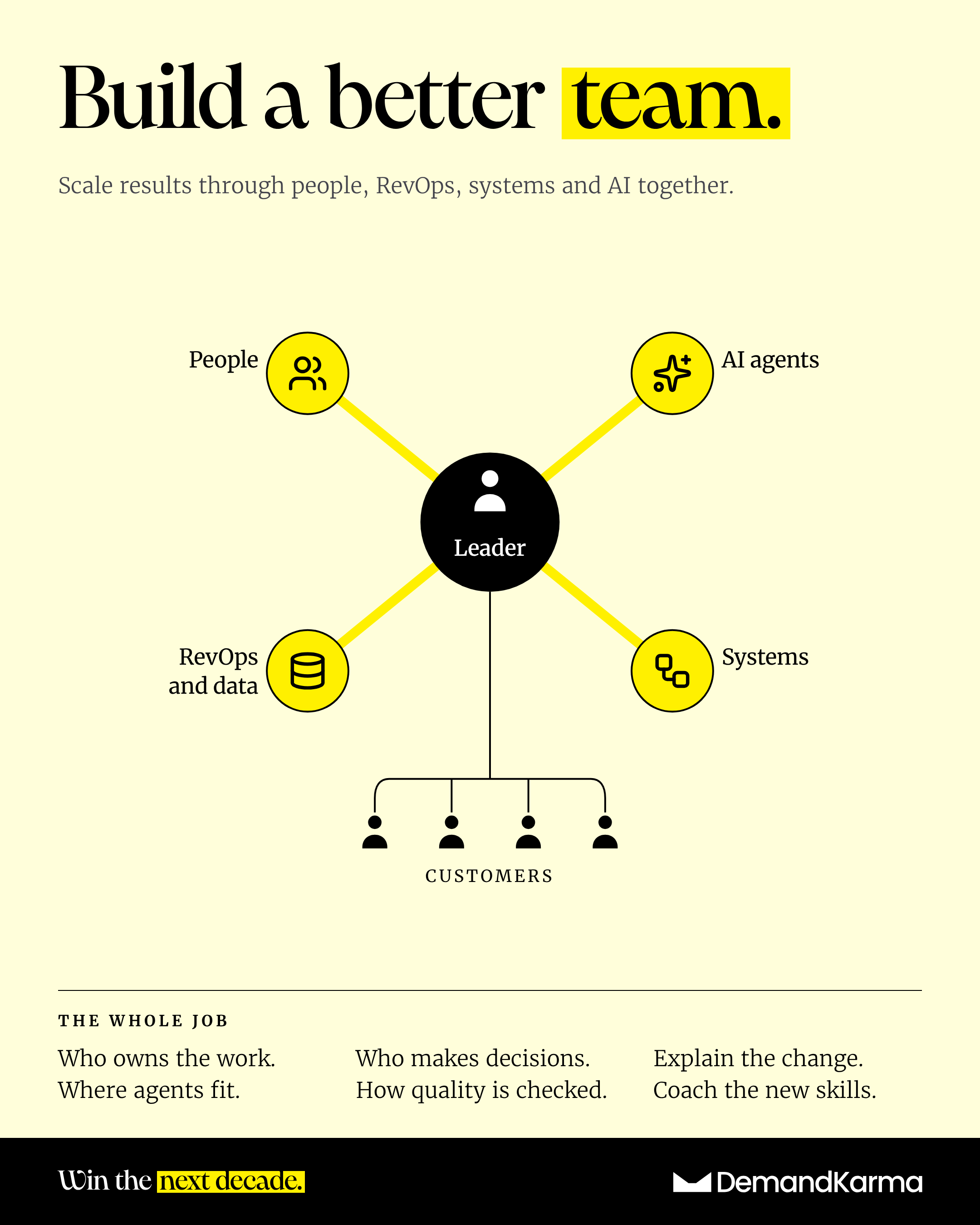
The job is to scale results through people, RevOps, systems and AI together. That requires the leader to work out how the function operates: which work people own, where agents contribute, who makes decisions, and how quality is checked. RevOps needs to make the data and processes reliable enough for the team to act on them.
People also need help as their responsibilities change. Someone who has been good at their job may suddenly be unsure what’s expected of them. The leader needs to explain the change, listen to concerns, and coach the skills they now need.
The leader’s number one job has always been to build a better team around them.
Making leadership legible
For investors, that should be the test behind the AI narrative. Are people becoming more capable? Are responsibilities clearer? Is the leader coaching, making better hiring decisions, and helping the team exercise sound judgment?
Be careful not to assume better agentic workflows mean better leadership and results. A scale-up can improve its agentic workflows while its leaders still avoid difficult performance conversations, leave strategic decisions unresolved, and disagree about which customers to pursue.
Much of a leader’s job is aligning peers on priorities and working through trade-offs. Better processes and agentic workflows won’t resolve those issues on their own.
All three people could become the leader the business needs, but the development involved may differ. The proven operator may need to rethink an established approach. The high-potential leader may need support as they take on greater responsibility. The technical IC may need to learn to achieve results through others and develop softer leadership skills.
The CEO needs to understand those needs before deciding who to back. What improvements are needed, what support would help, and can the person make that progress in the time available?
This Week’s Tangible Prompt
Set aside an hour and reflect on leadership:
- What will the business need to do by year-end that it struggles with today? Be specific about the results required and what needs to change.
- Can the current leadership team deliver that change? Look at recent decisions, how leaders handle difficult conversations, and whether they turn agreed priorities into action.
- What support would close the gaps? Identify who needs coaching, practical experience, or specialist support, and where the team needs strengthening.
If the GTM plan depends on people working differently, the plan needs time for their development. That includes the person leading them.
Making leadership legible means understanding the whole job, including the parts someone still needs to learn. The CEO and board can then decide whether to support that development or bring in different experience before losing more time and investment.
Will the people who got you here take you where you need to be?
Cheers,
Edwin & Josh
Reading is free. Waiting isn't.
If an essay hit a nerve, that nerve is usually worth a conversation.
Book a callGet the essays before your competitors do.
New essays land here first. Free, weekly, unsubscribe whenever.