Still none the wiser.
Why marketing updates leave the board guessing.

I was reviewing another board report and, again, the marketing report was very low from a maturity perspective. You get very generic goals with activity-based reporting, without enough context to understand how Marketing is performing.
From a board perspective, we need to raise that maturity level so marketing can give us more context on how the pipeline is building, what’s working, what’s not working, and where to focus channel efforts and capital allocation.
A Chair I worked with years ago put this well. When I joined that company, the board report was very operational. If a number dropped or a target was missed, he could see that. What he wanted to know was: do we understand why? How concerned should we be? What action are we taking?
A seasonal blip and a channel that has stopped working need different responses. Investors outside the business need that context.
Look beyond attribution and demand generation
The CEO and board don’t always know what to look at in a marketing update. They want to understand marketing’s contribution, so they ask the team to show which marketing spend produced revenue.
That’s how the conversation becomes focused on attribution. The team adds tooling and puts more effort into tracking. That can improve the information available, but the board still needs to understand how the plan will build enough pipeline and where to focus investment.
The other response is to narrow marketing to demand generation or put it under Sales. That can bring closer alignment around the quarter, while leaving positioning, brand and expansion with less attention because their contribution is harder to measure.
Some boards do none of this. They keep accepting activity updates because nobody has given the team a clear view of what should replace them. That leaves us making decisions about budget and people without enough understanding of the problem.
Expect the leader to explain the strategy
The best marketers I know study their craft. They understand buyers, find gaps and try things other people in their industry aren’t doing. We should be able to hear that thinking in the plan.
Can the leader explain the choices behind content, field marketing or demand generation? Or would we get another list of tactics, all tied back to MQLs and what can be measured?
The category and market update should explain where the company wins and loses, by segment and why. Ask what buyer conversations changed in the targeting, proposition or messaging, including who the company has decided not to target.
A plan built only on capturing demand misses where deals are decided. Ask what the brand and category bet is, over what time horizon, and what early evidence shows it’s working.
Buyers can research inside an LLM without visiting the website. Answers draw on different sources. The company doesn’t see those interactions, and buyers may arrive much further into their decision.
Falling traffic with steady first meetings and qualified pipeline tells a different story from all three declining. The board needs evidence behind the explanation. AI can’t become the excuse for every number going down.
As I covered in Is Marketing working?, buyer conversations help explain the numbers: where they first heard of the company, what put it on their shortlist and why they engaged. Traffic alone doesn’t prove brand awareness.
“Our AI visibility score is not the goal.” Ask which buyers and questions it represents. But demanding immediate attribution for every brand investment takes us back to funding only what is easiest to count.
Internal teams and LT need to understand what marketing is trying to achieve and where their contribution matters. That applies to the board as well. We need to give the leader room to explain the strategy, then test the assumptions and results. Changing the leader won’t improve our understanding if we keep asking for the same update.
Agree what good reporting looks like
A few slides, with clear quarter-over-quarter trends and relevant benchmarks. Cover the market, issues addressed last quarter, results, next quarter’s priorities and targets. Detailed breakdowns belong in the appendix.
The CEO and Chair own the pack, with leaders owning their sections. Agree reporting expectations with the marketing leader: monthly numbers and context, perhaps, with quarterly depth. Share an anonymised, redacted example. The leader still owns the strategy and recommendations.
Is 2.6x pipeline coverage enough? The target has to reflect the company’s conversion rates, segments and sales cycles. A generic 3x won’t do. Without reference points, the board guesses, and may assume the team is spinning.
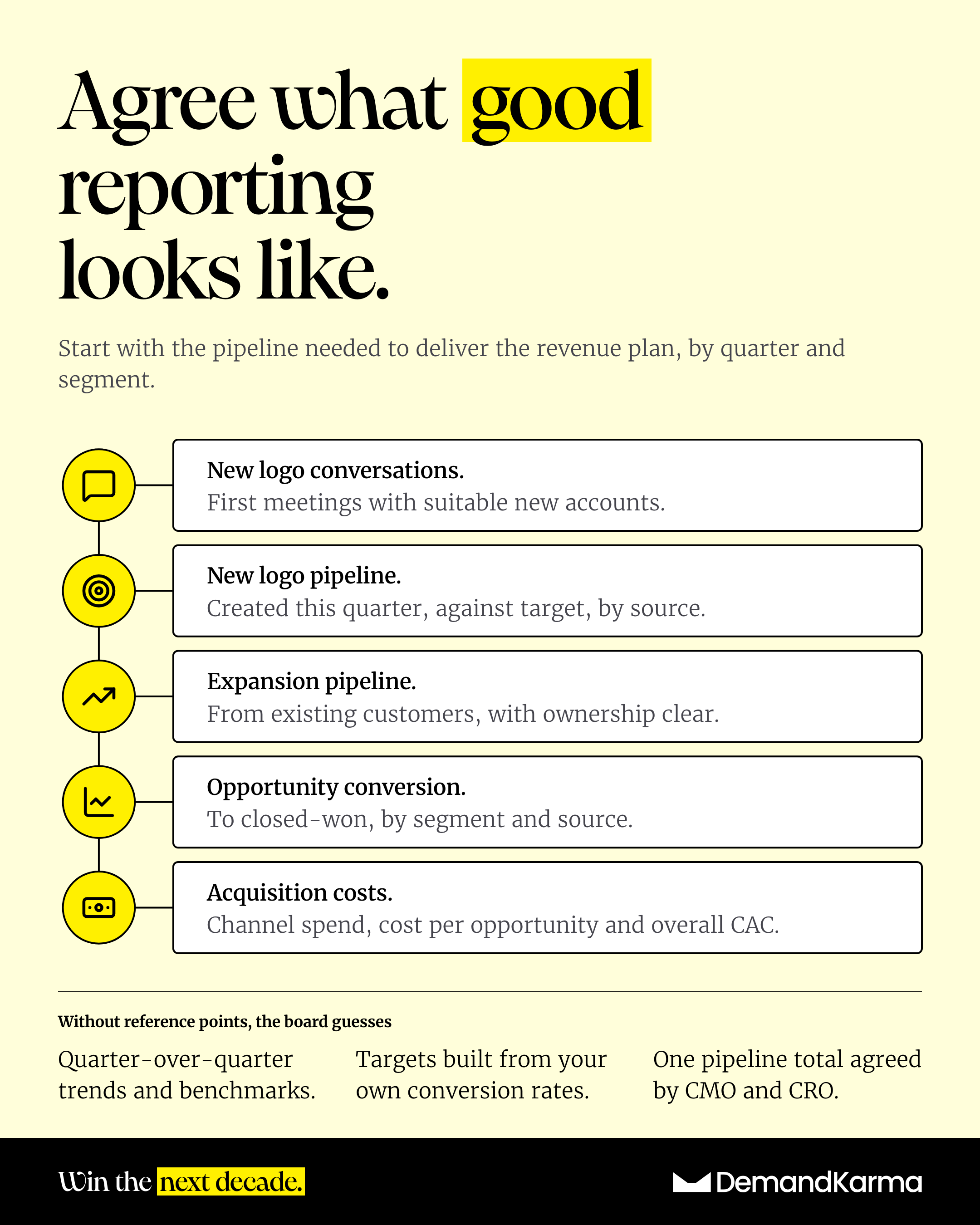
I’d start with the pipeline needed to deliver the revenue plan, built by quarter and segment from the company’s conversion rates and sales cycles. The CMO and CRO should agree one total and who owns fixing a shortfall across sources. We also need to know whether Sales has the capacity to work it.
Some starting metrics:
- New logo conversations: First meetings with suitable new accounts and conversion into qualified opportunities. Demo and pricing requests where inbound contributes.
- New logo pipeline: Qualified pipeline created against target, with Marketing and Sales sources shown where meaningful. Separate pipeline created this quarter from pipeline expected to close this quarter.
- Expansion pipeline: Qualified pipeline from existing customers against target, with ownership clear across Marketing, Sales and CS.
- New logo opportunity conversion: Opportunities to closed-won, with differences by segment and source explained.
- Acquisition costs: Channel spend, cost per opportunity and overall CAC. CAC by channel where the cost allocation and attribution are reliable enough to support the comparison.
Enterprise outreach and regular inbound won’t produce the same volumes or early signals. Many companies use both. Attribution remains one input: an outbound opportunity may have been helped by content, an event or a recommendation.
Compare like periods and allow for the sales cycle. Ask why conversion is improving or declining, the evidence behind that view, and the adjustments being made. If a previous adjustment hasn’t worked, the board needs to hear that too. Establish whether the shortfall is temporary or requires a change to the plan.
Ask what share of next year’s pipeline comes from existing customers and what Marketing, CS and Sales will do to generate it.
Understand what’s changing and where to invest
The budget should show which experiments produced pipeline, what they cost, and which stopped. If the team wants to scale an experiment, ask for the expected return and timing: £X invested for £Y of pipeline by Q3. Agree how long new tests will run and what results justify further funding. Before approving the budget, I’d also ask what 20% less would remove and what 20% more would add.
If the plan assumes AI will improve growth or efficiency, I’d want to understand what changes in the work.
Marketing, Sales and CS should use shared customer information. If AI helps analyse won and lost deals, ask what the findings changed across the teams. Separate tools and customer records can leave each function working from a different understanding.
The leader should explain how experienced people set quality standards, review the work and use corrections to improve it. If AI produces more content, ask whether that work improves pipeline or win rates.
The operating plan needs to reflect how the work changes. If execution and reporting take less time, where do research, positioning, and enablement need stronger skills? What training is planned?
“This is how my own role is changing.” The plan depends on the leader’s judgement about AI, not just the team’s tools. Establish whether the leader can explain what AI changes in their own decisions, and what support they need.

This Week’s Tangible Prompt
At the next board meeting, I’d ask three questions. You change the focus by asking better questions.
1. How much pipeline do we need to create this quarter to hit next year’s first-half number?
I’d want to see what’s missing in each segment and what the team is doing about it. Given how long those deals take to close, are we leaving ourselves enough time?
2. Where would you move 20% of the marketing budget based on the results?
Name what loses funding, what gains it and the effect on pipeline you’d expect. Make the assumptions clear.
3. What did you change following the last board meeting and did it work?
Take the result and put it against the original expectation. What needs to change now and where would board input make a real difference? The update should finish with what’s working, what’s not, what’s changing and clear asks to the board.
Back to that report I was looking at. I’d want to be very clear with the team that the board has an update that’s valuable for decision-making around how marketing is working or not, not updates on the key projects. The update can mature incrementally, but keep working on it.
Final point: have we actually explained what good looks like, or are we just going to expect the leader to work it out? If they’re not an experienced marketing leader with the right experience, then you’re going to be waiting many cycles for that to happen.
Don’t let it.
Cheers,
Josh & Edwin
Reading is free. Waiting isn't.
If an essay hit a nerve, that nerve is usually worth a conversation.
Book a callGet the essays before your competitors do.
New essays land here first. Free, weekly, unsubscribe whenever.