Stop spending. Start allocating.
Marketing should be treated as capital allocation, not an annual spending entitlement.
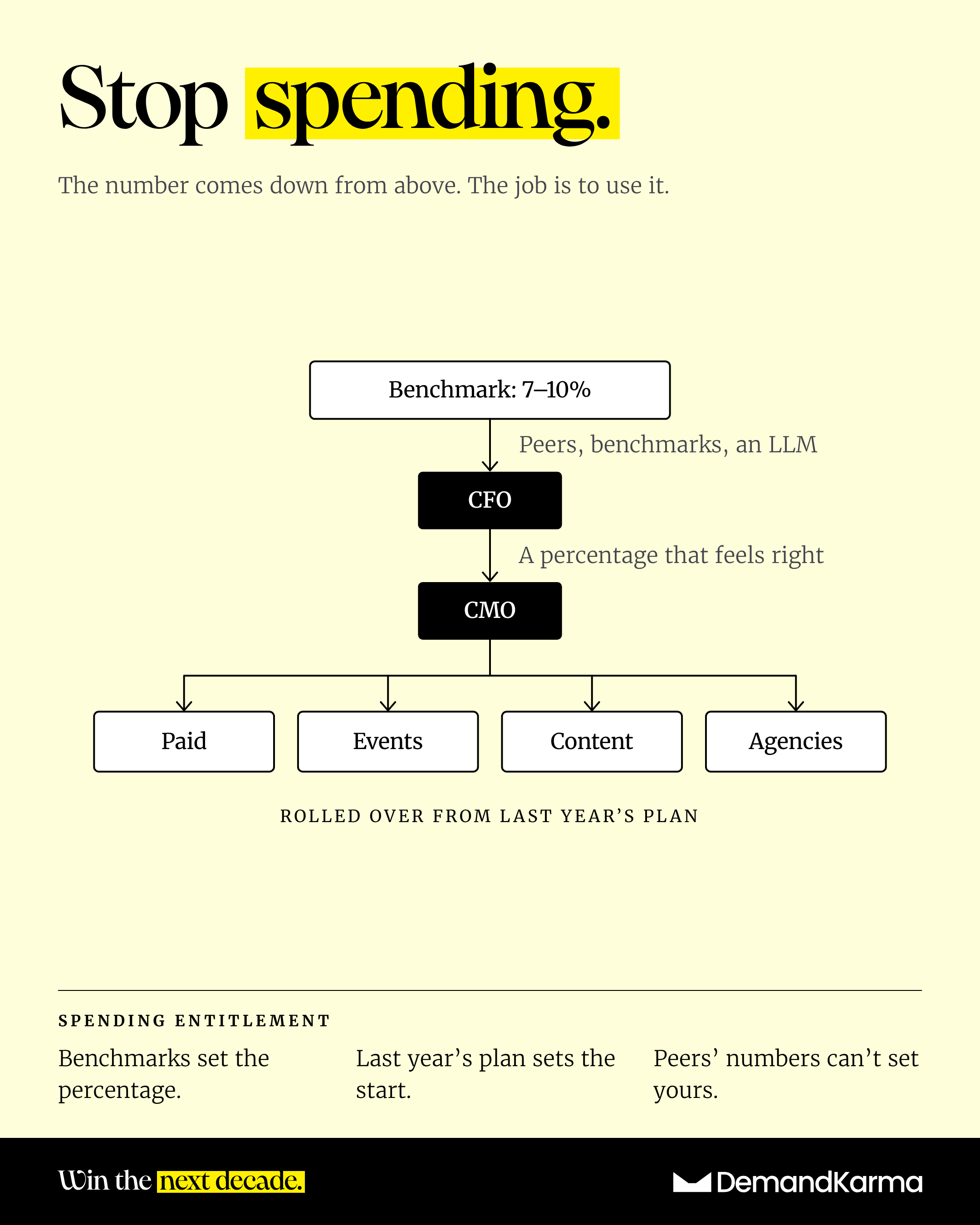
A good CFO called Sarah told me how she sets marketing budgets. She looks at the benchmarks, gives the CMO a percentage that feels right (it’s normally 7%–10%), then trusts them to decide where it goes. She is relying on the CMO/CRO to turn that number into the right ARR growth.
I did the same thing. When I was a CMO, I got my budget and then looked for places to spend it. The number came down from above, and my job was to use it. Last year’s plan gave me somewhere to start.
I see this across venture portfolios now. Eight times out of ten, leaders see their budget as what they can spend rather than what they are going to invest. People ask peers, copy benchmarks or ask an LLM. But someone else’s percentage cannot tell you what your go-to-market motion needs.
An Operating Partner taught me to look at this differently. He was helping a CMO who was focused on channel spend. He brought the operating plan back to four measures: new-customer CAC ratio, CAC benchmarks for businesses between £5M and £20M in revenue, marketing’s share of total sales and marketing spend, and where program spending goes.
The change was a more balanced view of marketing. Paid ads and other directly attributable channels were part of the picture, alongside investment in brand and future demand that would not show up neatly against short-term pipe.
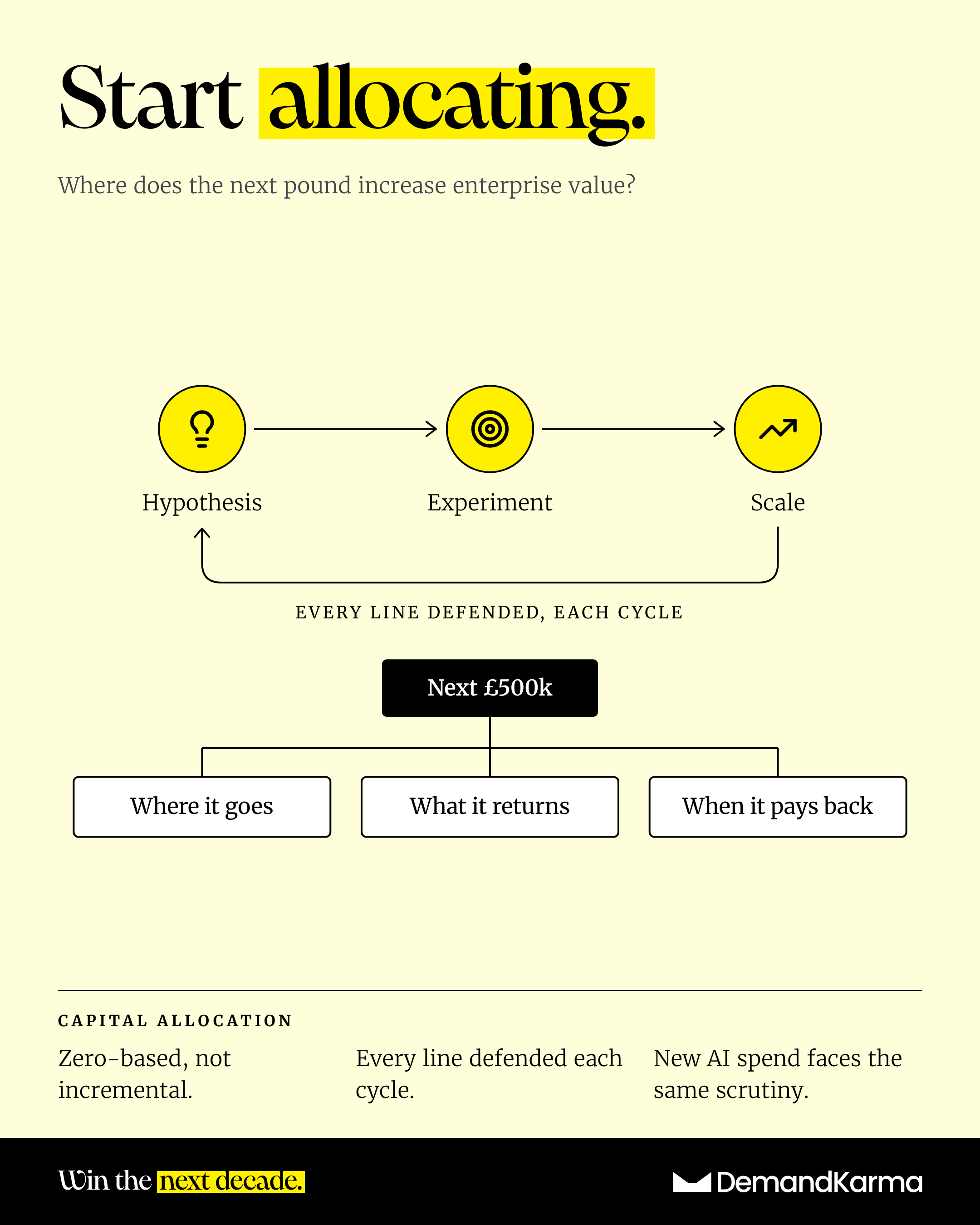
The point being, a better way to think about the budget is through capital efficiency. The goal is not to spend 8%, 10% or 15% of ARR. It is to understand where the next pound of investment increases enterprise value. The right allocation depends on the outcome you are trying to drive.
In addition, I always had to explain the delay between investment and return. Hire a Demand Gen person now, see pipeline increase in a quarter, and the sales could come six months after that. The Magic Number uses a one-quarter lag; that may not fit your sales cycle. Forecast the delay and agree the early indicators, such as qualified pipeline and deal progression.
My personal approach to solving investment strategy and allocation was to use a hypothesis, experiment, then scale process. Some money paid for testing and learning, so we could scale more confidently on top of the existing motion, rather than hoping something new would work at scale immediately.
AI adds another decision to that process. There is pressure to become more efficient and show the board that the business is becoming AI-forward. But someone telling you that everything is now about agentic workflows is not an investment case.
For example, if events generate most of your ARR, they may deserve more investment. The money should go where the business can put it to good use, whether that is events, people, agencies, or AI.
I would apply the same thinking to AI. Which existing costs does it remove? Which capabilities does it improve? Are any savings being reinvested productively? It may change how marketing operates, but that change still needs to produce a commercial benefit.
Because you risk adding cost while thinking you are becoming more AI-focused. You are spending money to improve processes without a revenue mindset behind it. The board gets evidence that the company is adopting AI, but no clear explanation of why that was the best use of the money. And remember, good marketing also builds brand and future demand; the new world isn't just allocating time and money to building agentic workflows that will cure all problems.
Marketing should be treated as capital allocation, not an annual spending entitlement.
That means a budget as a living model, not an annual exercise. Zero-based, not incremental. Every line justified from scratch each cycle. Incremental budgeting protects existing spending by default. Zero-based budgeting forces someone to stand up and defend it each cycle, or it loses its funding. New AI spending should face the same scrutiny.
That does not mean every investment must pay back within a quarter. It means the hypothesis, timescale, and evidence must still justify funding it.
I would use five metrics to assess that capital. Marketing capital productivity is marketing expense divided by marketing-sourced new ARR. Pipeline capital efficiency is marketing expense divided by qualified pipeline created. Acquisition efficiency means fully loaded CAC and gross-margin-adjusted payback.
Incremental return measures the additional gross profit generated by incremental investment. Capital reallocation measures the percentage of budget moved from underperforming to higher-return investments. These are how I would test whether the money is being allocated well.

Good looks like a marketing team that can tell you, before the money goes out, where the next £500k will go, what it should return, and when you’ll get it back. Then they can show you afterward whether it did.
These five metrics tell you how to check. The first two show how much you pay per pound of pipeline and per pound of new ARR. Payback shows how many months it takes a new customer to earn back what it cost to win them. Incremental return shows whether extra spend is still bringing in good customers, or just more expensive ones. Reallocation shows whether you’re taking budget away from channels that have stopped paying back and giving it to the ones that are.
Most companies track the first two. Very few track the last two. That’s usually where wasted budget sits.
For a £2M–£20M ARR business, the quarterly board review needs to connect marketing investment to new ARR, gross margin, payback, retention, and the next allocation decisions. I want to know what proportion of marketing capital is genuinely being reallocated, versus being rolled over because it was in last year’s budget.
Knowing how much to spend isn’t the same as knowing how to invest.
Sarah can give the CMO a percentage. But as an investor or CEO, are you confident your CRO and CMO can allocate it effectively? Can they explain where the next pound should go, what return they expect, when it should arrive, and what evidence would make them stop or scale?
If they cannot, what gives you confidence that next year’s budget will be better allocated than this year’s?
Cheers,
Ed & Josh
Reading is free. Waiting isn't.
If an essay hit a nerve, that nerve is usually worth a conversation.
Book a callGet the essays before your competitors do.
New essays land here first. Free, weekly, unsubscribe whenever.