The battle of differentiation
Differentiation is becoming harder to build and easier to defend badly.

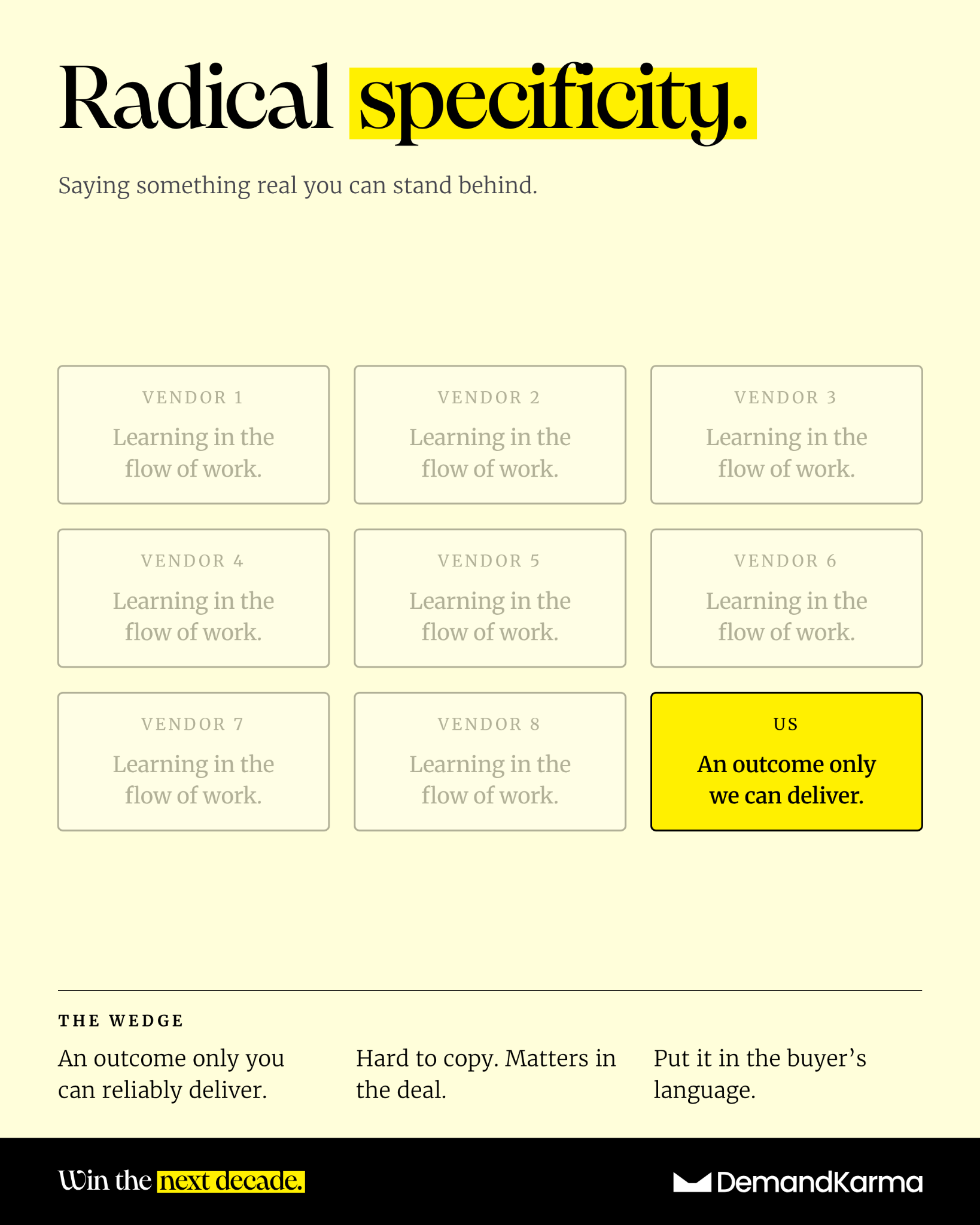
About ten years ago, I was working in EdTech a customer was doing a day where all vendors were invited to present. There were nine of us, and me and the CRO were ninth to present. We’d created this fantastic deck with what we thought was amazing differentiation versus our category.
As presentation one went, presentation two went, presentation three went, presentation four, what we realized was that our differentiation was actually not differentiated. We were saying exactly the same thing as all our competition.
At the time, everyone had picked up “learning in the flow of work”. Basically, every vendor differentiated themselves by saying they were the product that helped users learn in the flow of work.
That old-school example is now what’s happening in real time, week on week, with LLMs. Just online.
In this day and age with LLMs, differentiation is becoming more strategically important than ever.
Gartner’s February 2026 research reported that 60% of B2B buyers are turning to generative AI in some form to shape their purchase decisions.
Why that’s important is because people are turning up to calls with a predetermined shortlist already in their minds. With a clear view on what each vendor does in their category, as they’ve researched why they believe or think you might be different.
So the problem you face within marketing is that your differentiation at the top of the funnel is super important. Your buyers are getting written explanations of differentiation from LLMs. The distinctiveness of your brand is super important when people are looking in black and white, just at words, at you and your competitors.
Before, you could educate the buyer more effectively at the top of the funnel. Now they’re coming to you much more informed, with a clear shortlist, and they’re putting all of you against each other. They’re comparing you against the specific problem they’re trying to solve.
Then they’re looking for confidence. Who is the vendor that has the stories and the narrative that convinces them they’ll be successful, alongside feeling that the product is differentiated enough to solve their problem?
As Gartner’s Robert Blaisdell said in May 2026: “Buyers still turn to sales reps to validate AI-generated insights.”
You’re facing a battle of differentiation right now, and the battle of differentiation is the battle for survival.
Before going any further, it’s worth being clear on what I mean by differentiation because I think companies confuse being different with having meaningful differentiation.
Good differentiation matters to the buyer in the deal and is hard for a competitor to copy.
Having a feature your competitor doesn’t have doesn’t automatically make you meaningfully differentiated. If the buyer doesn’t care about it, it won’t change the buying decision. Equally, you might genuinely have something different about your product, approach or expertise, but if the buyer can’t understand it, it isn’t doing much work for you.
That was exactly what happened to us in that EdTech pitch. We thought we had differentiation. In reality, we had a claim that sounded differentiated inside our company but became completely generic the moment we heard the rest of the market saying it.
LLMs expose this much earlier in the buying process.
A buyer can now compare you against five competitors before speaking to any of you. Marginal product differences get exposed as marginal. Generic claims get grouped together. And differentiation that might genuinely exist but hasn’t been communicated clearly can disappear completely in the summary.
So the test I keep coming back to is simple: does it matter to the buyer, can they understand it, and is it difficult for your competitors to copy?
If the answer to one of those is no, I’d question whether you have meaningful differentiation at all.
The other problem UK companies have is that we’re very shy about positioning ourselves boldly in a differentiated sense. US startups feel more comfortable doing that and putting it out in the market. So this is exacerbated in the UK because you’re competing against vendors that are being bolder with their differentiation.
Your balanced mediocrity won’t cut through the noise or help you win deals.

Ten million reasons why you’re differentiated
Most people solve this problem in ways that, in some ways, run counter to what they should be doing. Many are solving it through AI. They’re getting their marketing teams to go into LLMs to figure out the differentiation, and what comes out is a feature dump or ten million reasons why they’re differentiated.
It’s not sales enablement ready. But they start using it in marketing.
The CEO is also building their strategic narrative using LLMs. Unless you already have an established point of view, you’re going to create a strategic narrative that every other CEO in your category could make.
This is why we end up in a world of balanced mediocrity (once again!). Everyone is using AI to explain how they’re different, and everyone is coming back with the same messages.
Then there’s hiring a positioning or messaging consultant. Last week, I checked in with a CEO and said, “Are you clear on your differentiation?”
He said, “Well, we wanted to be. We hired a consultant who gave us a 40-slide deck with our differentiation, but we just can’t really understand how to use it.”
The problem is that a 40-slide positioning deck doesn’t create differentiation. You have to do the harder work underneath it first: understand what genuinely matters to the buyer, where you’re meaningfully different, and what you’re prepared to build your position around.
Weak differentiation has a commercial consequence. You get compared on features and price, sales has to work harder to explain why you’re different, win rates suffer and buyers have less reason to choose you over the alternatives. In a market where LLMs are doing that comparison before you even enter the conversation, that problem gets exposed much earlier.
The core is differentiation
The LLM differentiation doesn’t work because you create more messaging, rather than something specific and narrowed down. The strategic narrative doesn’t work because, unless you’re very good and already have an established point of view, you’re going to create something every other CEO in your category could make.
And the positioning consultant doesn’t solve it if they aren’t solving the core of your problem. The core is differentiation. Messaging comes off the back of it.
I believe AI makes differentiation harder to build and easier to copy. AI is compressing the lifespan of product differentiation.
Your product roadmap probably isn’t your differentiation strategy.
The common thing I see in portfolio reviews is founders pitching table stakes as differentiation. “We have AI.” “We’re easy to use.” “We have a great UI.” Every competitor says the same That’s not a wedge, that’s an assumption that doesn’t take a long time to figure out.
The real differentiated value is what you can do for a customer’s business that no other alternative solution can. An outcome only you can reliably deliver. A wedge they can’t copy.
Good differentiation is hard to copy and matters to the buyer in the deal.
How uncomfortably narrow are you?
The focus of the message you market with gets easier when you’re talking to someone specific. So the questions are: how uncomfortably narrow are you? Who do you serve? What’s the core of what you do?
Change from an ICP based only on “who they are” to “what just happened to them”.
“Target retail brands with high online traffic” becomes “target retail brands that just had product pages flooded by bots ahead of a new drop.”
“Target ticketing companies” becomes “target ticketing companies that just watched bots drain inventory within seconds of an on-sale.”
“Target gaming companies” becomes “target gaming companies that just had in-game economies hit by automated farming or account hijacks.”
If you’re struggling, think of negative benchmarking. Say there are two Michelin-starred restaurants in a city, and they look the same. You go to the other restaurant and find a weakness. Now, the weakness in that restaurant is its wine selection for example.
So you narrow down as the Michelin-starred restaurant with the fantastic wine selection. Your differentiation becomes narrow, focused on a competitor’s weakness, in language the buyer understands.
I look for differentiation across Product, Data, Distribution, Expertise, Brand, and Experience.
That could be proprietary data, a workflow nobody else owns, a distribution channel competitors can’t access or a founder insight baked into a product. It could be differences in your approach or model, backed up by similar customers you’ve helped.
Differentiation is backed by a strong point of view. Buyers want to know what you believe, and this helps inform your differentiation.
The distinctiveness of your brand
One way to create differentiation is through your brand’s distinctiveness. This is especially important when buyers compare written explanations from LLMs. They’re looking at words, in black and white, and your competitors may be saying exactly the same thing.
Christopher Nolan is a useful example. He wants the audience to experience the story alongside the characters, to feel like they’re in the maze with them, making mistakes and feeling the stakes. In Memento, the structure puts you alongside the character’s difficulty understanding what has happened.
He also makes deliberate choices about how the films are made. The rotating hallway in Inception was a physical set. His approach to point of view, camera work, and practical effects contributes to the experience of watching his films.
That’s the point about distinctiveness. A strong point of view comes through in the work. For your business, that needs to come through in the stories, the narrative, and the experience, as well as the written explanation of what your product does.

Put it in their language
Use the language your buyers use when they describe the problem, not the language you use internally to describe the product. Start with what they’re trying to solve and why it matters to them, then show how you solve it differently.
Companies tend to sell solutions to external problems, but customers also buy solutions to internal problems. They want confidence they’ll succeed. This is where the stories of similar customers you’ve helped and the specifics of your approach matter.
After hearing it once, a stranger should be able to repeat what you do and who it’s for. Use this as a starting point:
For [target customer] who [statement of need or opportunity], [product name] is a [product category] that [key benefit or compelling reason to buy]. Unlike [primary competitive alternative], our product [primary differentiation].
And the new test: does your positioning survive AI summarisation? Can an LLM restate who you’re for and why you’re different?
Clarity is now machine-readable, and machines are in the buying loop. But humans are still the buyer for now.
So make sure you’re very clear on your differentiation and can train everybody in it. The most important thing for survival in these market and buyer conditions is that your buyer can clearly understand why you’re distinctively differentiated.
Final tip: create a constraint
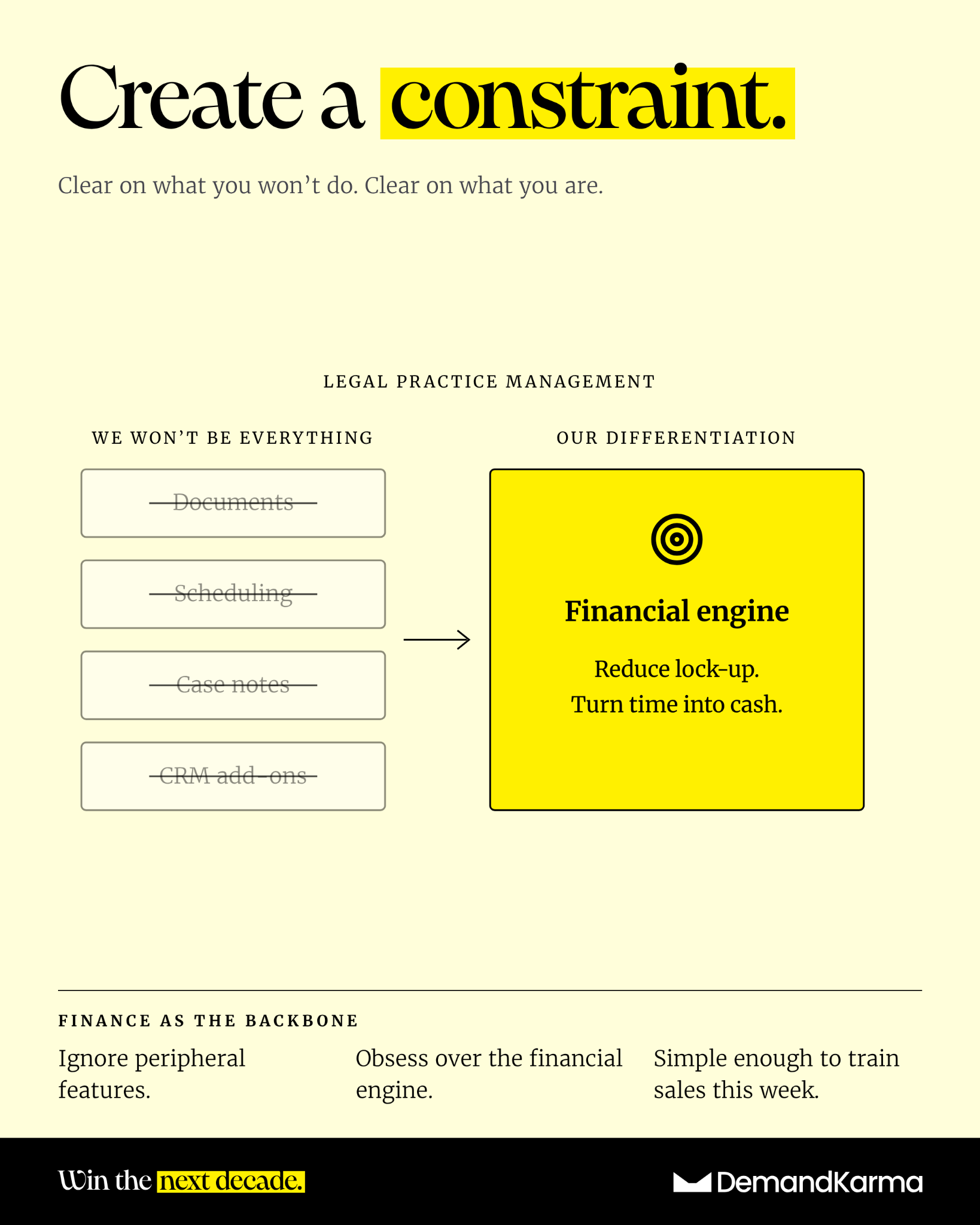
A constraint gives you an anchor on what you won’t do. If you’re clear on what you won’t do, you can be clear on what you are and how you’re differentiated.
And it needs to be simple enough to train all your salespeople in it this week.
Take the legal practice management software category as an example. Most players try to be all things to all firms: documents, scheduling, case notes, CRM add-ons. Everyone is saying, “We’re practice management for everything.”
One way to differentiate is to focus your messaging on finance as the core of what you do. Make the concentrated bet that the financial engine is what matters most, helping law firms reduce lock-up and turn time into cash faster.
The constraint is to ignore peripheral features and obsess over the financial engine. You’re clear on what you won’t do, so you can be clear on what you do particularly well and why it matters to the buyer.
Here’s a little framework for finding your asymmetric constraint idea
Here’s a little framework for finding your asymmetric constraint idea:
- Identify industry sacred cows. What if you completely eliminated what everyone considers essential? Robinhood removed account minimums. Casper eliminated showrooms. Zapier removed IT departments.
- Invert the status metric. If everyone optimizes for speed, optimize for depth. If everyone chases scale, chase intensity. If everyone builds comprehensive products, build a single-purpose tool.
- Weaponize a constraint. What limitation seems like a disadvantage? 37signals turned their small team size into a selling point, building products they needed internally rather than chasing market research.
- Find the emotional gap. What feeling is missing from the standard customer experience? Banking feels confusing, so Monzo made it simple. Enterprise software feels corporate, so Slack made it playful.
- Go irrationally niche. How can you focus so narrowly your competition thinks you’re crazy? (Spoiler: you can expand from there). If your idea doesn’t make some people uncomfortable or seem irrational, it’s probably not an asymmetric bet. The best startup ideas sound either obvious or crazy, nothing in between.
A note for investors
This matters for you too. Look at how your portfolio companies are strategically differentiated.
If they aren’t, they won’t win. Their value will diminish fast. They’ll lose in their category, and their valuation and story won’t create a return for your fund.
Nine vendors stood up in that room ten years ago and said the same differentiation.
Your buyers are watching that day play out every week now, in a text chat window.
Make sure you’re the one saying something different.
This Week’s Tangible Prompt
Ask your leadership team:
“If our three biggest competitors copied our features tomorrow, why would customers still choose us?”
Look at the answer across:
- Product
- Data
- Distribution
- Expertise
- Experience
- Brand
Then narrow it down to the one or two things that matter to the buyer in the deal. Put it in their language and back it up with the customers you’ve helped.
And in a world full of “brand blanding,” the real differentiator is radical specificity. Saying something real. Saying something you can stand behind. Having the courage to take a position and back it with empathy and evidence.
And please, a nod to UK startups: become un-British and get behind a bold differentiation strategy.
See you next week,
Ed & Josh
Reading is free. Waiting isn't.
If an essay hit a nerve, that nerve is usually worth a conversation.
Book a callGet the essays before your competitors do.
New essays land here first. Free, weekly, unsubscribe whenever.