Will this company still be viable in three years?
Over the last two weeks I’ve been talking to CEOs, CROs and investors about their 2027 plans.

The CEOs and CROs believe in the companies they’re running. I remember that from my time as a CRO. You’re thinking about maximising next year’s number. What can we commit to? Where’s the growth coming from?
Investors have money riding on the answer and see less of the day-to-day. They know what each company is worth on the fund’s books. In three years, will it be worth substantially more? Could they realise that value at exit? Would they put more money in along the way? Will the company still be viable?
What struck me is that investors ask each other those questions. Then they sit down with the CEO and agree a budget without the board going deep to answer them. They leave knowing the number and still unsure what will make the company worth backing in three years.
The budget answers twelve months. The fund is asking about thirty-six.
I’ve seen teams spend another quarter improving the current plan. Build more pipe. Ship the next feature. Meanwhile, AI has shortened the lead that shipping software used to buy. Where does that leave us exposed? What do customers still choose us for, and would investing more in it help us win new business, keep customers and grow those accounts?
I often get the call once win rates have dropped or customers are cutting back at renewal. By then the board can see the problem. The team may have run out of time to fix it.
What next year’s numbers can hide
Take a company whose customers have spent years embedding its software. Renewing may be a perfectly sensible decision. A new buyer has nothing to migrate and no one to retrain. If a competitor can use AI to build a cheaper version that does the job well enough, why would a new buyer choose you?
The board can take comfort from renewals at the very meeting where it approves a growth plan that depends on new customers.
It works the other way too. Suppose years of customer data have made the product more accurate than anything a competitor can offer. How much is that worth? It depends on what a mistake costs the buyer. If that accuracy decided recent deals in one part of the market, the board has evidence for putting more product and Sales investment behind those customers.
How the board should assess company viability and moats
These thirteen questions come from Demand Karma’s Portfolio Viability Review. I use it with investors and CEOs to diagnose their current situation. That helps us decide which risks need attention and which strengths deserve more investment.
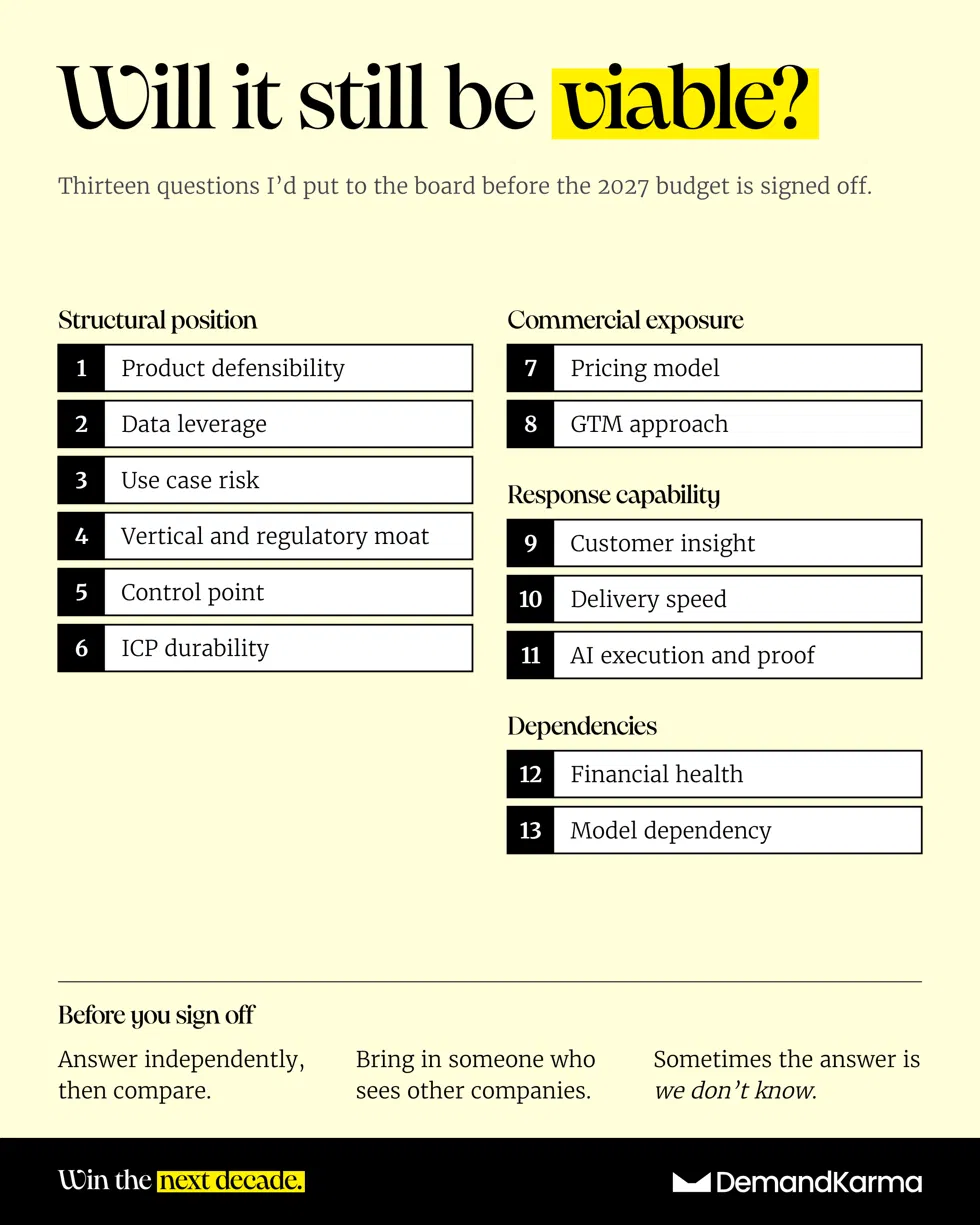
Structural position
- Product defensibility. If someone copied our software, what else would they need to deliver the same outcome?
- Data leverage. What can we do better because of data we’ve earned or a network we’ve built?
- Use case risk. What does a mistake cost our customers, and what level of accuracy do they need from us?
- Vertical and regulatory moat. Which industry requirements have helped us win deals that a competitor couldn’t?
- Control point. If an AI agent does the work, which steps still have to run through our product?
- ICP durability. What’s happening to the companies, roles and budgets we’re relying on for next year’s growth?
Commercial exposure
- Pricing model. As usage changes, does our pricing reflect the value customers get, and can they budget for it?
- GTM approach. Is pipeline built on channels that AI is weakening?
Response capability
- Customer insight. Would we know if customers had started looking at doing the work elsewhere before they told us at renewal?
- Delivery speed. Can we ship what customers need before a competitor, or the customer, builds it?
- AI execution and proof. Of the AI products we’ve sold, which are customers using in production, expanding and renewing?
Dependencies
- Financial health. Can we fund the changes we need before cash runs short or debt falls due?
- Model dependency. What happens if our model provider raises its prices, changes its terms or launches a competing product?
I’d have the CEO and board members answer independently, then compare the evidence where they disagree. Bring in someone who sees other companies facing the same choices to challenge the strengths everyone takes for granted. Sometimes the honest answer is we don’t know. If a sizeable part of next year’s growth depends on it, finding out comes first.
Some things the exec team can fix in a couple of quarters. The longer bets belong with the board.
A CEO I worked for a few years ago told me his number one job was to make sure we didn’t run out of cash. I think about that when I look at what a team has time to fix. If the rebuild takes two years and you’ve only got 12 months of cash, it makes little difference that you know what needs to be done. A fixable problem can still be fatal.
That’s a board decision today.
So is the upside. If buyers in one market keep choosing you for something competitors can’t match, are you investing enough to pull further ahead?
Before signing off the budget, I’d want the Chair to ask one question.
Given what we now know about this company’s viability risk and upside potential, what are we choosing to fund in 2027?
Reading is free. Waiting isn't.
If an essay hit a nerve, that nerve is usually worth a conversation.
Book a callGet the essays before your competitors do.
New essays land here first. Free, weekly, unsubscribe whenever.