It’s board season
We’re back from summer and board meetings are starting again.
We’re back from summer and board meetings are starting again. I spoke with a few chairs and investors during the week and we got onto AI-era GTM.
What was top of mind was how the rules have changed. What that means for pipeline, for MQL and SQL, for how you read leading indicators now. How you build a team ready for the market. How you set the operating model up so it works.
Then the bigger one. Alongside the normal board points, what else should be top of mind going into 2027, and how are these portfolio companies going to win in their category?
For me, the most important question is this:
“Looking at our 2027 plan, where are we relying on the GTM team to work differently, and what will they need from us to make that possible?”
September is a particularly important moment to work through that.
For a company with a calendar year end, I’d expect a draft 2027 budget by the end of October/November. Some will have a freshly updated plan. For many, it will still be a work in progress.
At the same time, the forecast for the current year is becoming clearer. You know roughly where you’ll finish against your targets. If the July board meeting was the H1 review, September is where that picture starts to meet the decisions about next year.
I think a lot of boards will be looking for higher growth in 2027 than in 2026. You can always create a model that shows a higher number. The question is whether you have the right people, thinking and doing the right things to achieve it.
The difficulty is understanding what AI-era GTM means for the business beyond individual use cases.
You can see that the team is adopting AI. But what does that tell you about whether you have the right commercial approach, the right capabilities and a plan that reflects what’s happening in your market?
That’s the part of the discussion I’m interested in.
Most boards approach the AI question by getting an understanding of what workflows are being built and what processes are being put in place. It gives them a view of the work underway and the efficiency gaps the team is addressing.
That’s a reasonable place to start.
But from what we’re seeing, a lot of GTM leaders are still catching up with the change rather than leading it. SaaS-era thinking with AI bolted on. The workflows may be developing while the thinking behind the plan stays much the same.
In a controlled experiment involving 249 participants, Harvard researchers found that who led the team explained more than half the variation in performance, whether the team consisted of people or AI agents. The more effective leaders asked more questions and encouraged more back-and-forth discussion. Harvard Business School AI Institute
For me, a big part of AI-era GTM is the mindset shift of the leadership team.
How are they thinking about building hybrid teams and executing with AI? How does that affect the way the commercial functions work together? What does it mean for how they assess performance and decide where to invest?
People are transitioning on the job right now. They’re working through these questions while continuing to lead their teams and deliver against the current plan.
Understanding what would help them is part of the board discussion too.
The opportunity is to improve feedback loops, iterate product development and keep validating positioning and differentiation. Over time, those improvements can compound and help the business compete in its category.
But understanding whether that’s happening takes a broader conversation than reviewing the use cases.
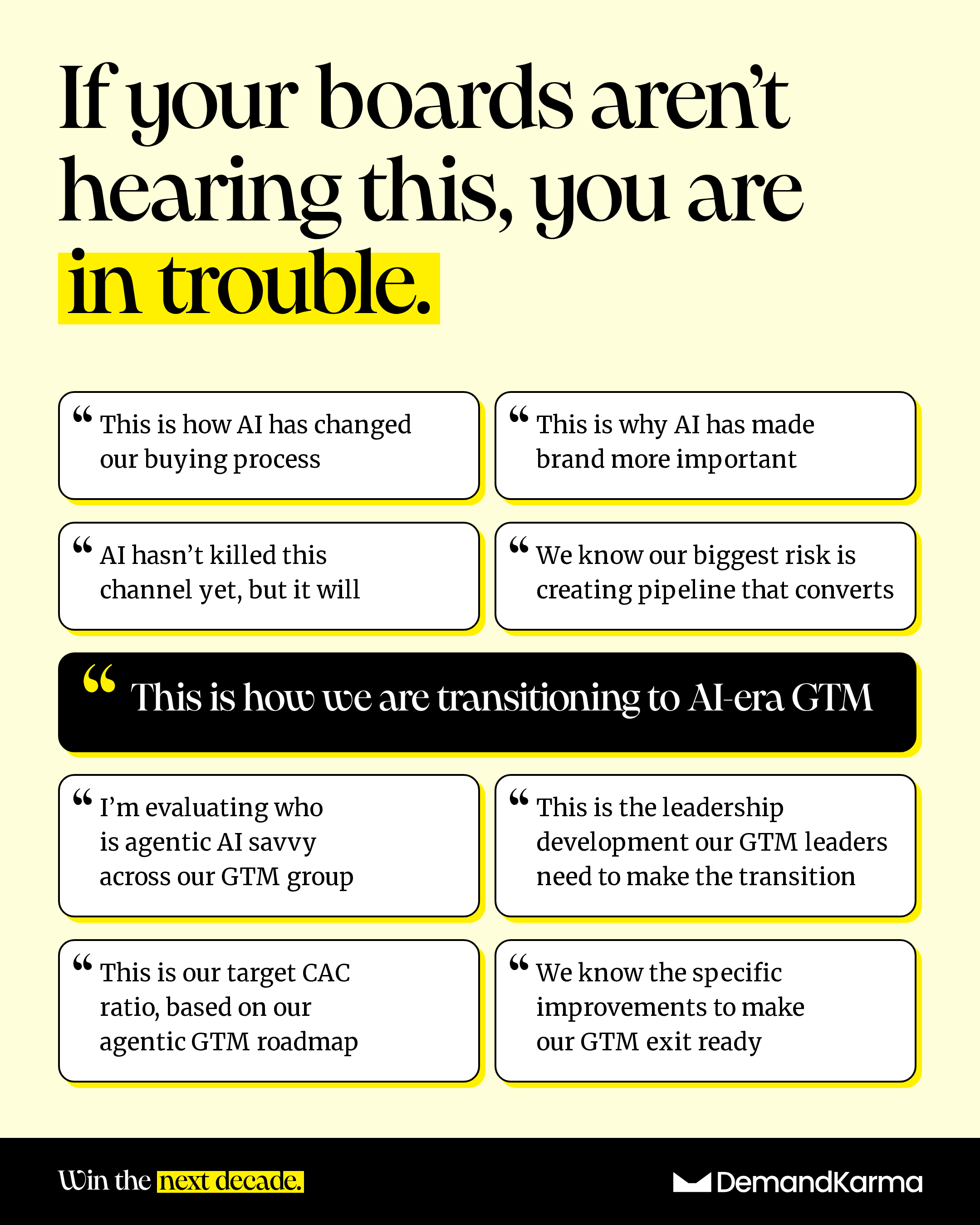
I’d bring the themes coming up in these conversations into the board discussion as questions:
- How has AI changed the buying process in our category, and what are we seeing in our own business?
- How are we transitioning to AI-era GTM?
- Where is AI making brand more important to how we compete?
- Which channels could be disrupted, and how are we thinking about that risk?
- Where is our biggest risk in creating pipeline that converts?
- What should our target CAC ratio be, based on our agentic GTM roadmap?
- Where do we have agentic AI capability across the GTM group?
- What leadership development would help our GTM leaders make the transition?
- Which specific improvements would make our GTM more exit ready?
A lot of this connects to discussions already happening at board level. The value is in working through what these questions mean for the particular company and the decisions coming up.
The people behind the plan.
The year-end people review is one example.
Alongside performance, there’s an opportunity to discuss whether the team has the capabilities it needs for next year. Where is experience developing? Where would additional support help? Are there gaps that affect what the business can realistically take on?
A leader may understand the direction but still be working through how to organise the team around it. That gives the chair and CEO something specific to discuss together: the development, expertise or changes in responsibility that would help.
Where changes are needed in strategy or people, September gives us time to act. If those decisions wait until January, we risk spending Q1—and potentially H1—making changes the plan already depends on.
The same applies to next year’s plan.
How is the transition being reflected in the operating model, the investment decisions and the assumptions behind the numbers? Where does the GTM roadmap support the commercial objectives? What still needs to be worked through?
That makes it possible to discuss the transition alongside pipeline, performance and people throughout the planning process.
When performance and planning are behind.
If a company is already behind on performance and planning, I’d want to establish a clearer picture of where the gaps are before agreeing the next set of commitments.
That could mean a focused GTM review covering pipeline conversion, channel performance, leadership capability and the operating model. An independent perspective can help where the same questions have been coming up over several board meetings.
The outcome would be a practical roadmap that the leadership team and board have helped shape.
From there, I’d focus on the priorities that have the greatest bearing on next year’s performance. What can we move forward now? What needs more work? Where can the board help with experience, connections or investment?
That gives the discussion a connection to the work happening between meetings.
This Week’s Tangible Prompt
“Looking at our 2027 plan, where are we relying on the GTM team to work differently, and what will they need from us to make that possible?”
It brings the performance expectations and the support behind them into the same conversation.
We may agree that the business needs stronger pipeline conversion, a different team structure or better acquisition economics. Working through what those improvements involve is where the plan becomes more specific.
You can agree a new GTM plan in a board meeting. Becoming the team that can deliver it takes longer.
Maybe that means investing in a leader you already rate. Maybe it means bringing in experience the team doesn’t have. Or giving someone room to work through a change while accepting that something else will have to wait.
People are making this transition on the job. The development they need belongs in the plan alongside the results we’re hoping for.
That’s where those conversations about 2027 brought me back to the people leading these businesses.
By January, they’ll be carrying next year’s number. September gives us time to work out what they’ll need to get there and put some of it in place.
Cheers,
Edwin & Josh
Demand Karma works with boards, investors and GTM leaders dealing with this now. If you have cut the GTM team, added AI and the number has not moved, the answer may not be another tool.
The AI GTM Leadership Kickstart is a short, structured programme for leadership teams to work through what changed, what still works and what no longer does, applied to their live GTM challenges. Leadership Development sustains it. Both are for the people who carry the number.
Reading is free. Waiting isn't.
If an essay hit a nerve, that nerve is usually worth an audit.
Book a callGet the essays before your competitors do.
New essays land here first. Free, weekly, unsubscribe whenever.