Your AI-first GTM team needs time to execute
How to stop internal AI information bloat killing your GTM team’s ability to focus and execute.
At the end of June, I was talking to the CRO of a $15m ARR company selling mostly to the mid-market. His team was heading for 117% of its H1 target, and he was actually looking forward to the July board meeting. A welcome change from the year before. But his people were telling him they lacked time and felt mentally tired. He could see execution slowing and was worried about burnout.
The company had fully committed to AI-first GTM at the start of the year, following experimentation and decent adoption the year before. The team came into the year leaner, with a mandate to start by asking how AI could improve the work or do it. More ABM campaigns, greater personalisation and better sales opportunity insights had helped performance. Internally, the same approach was creating work faster than people could get through it.
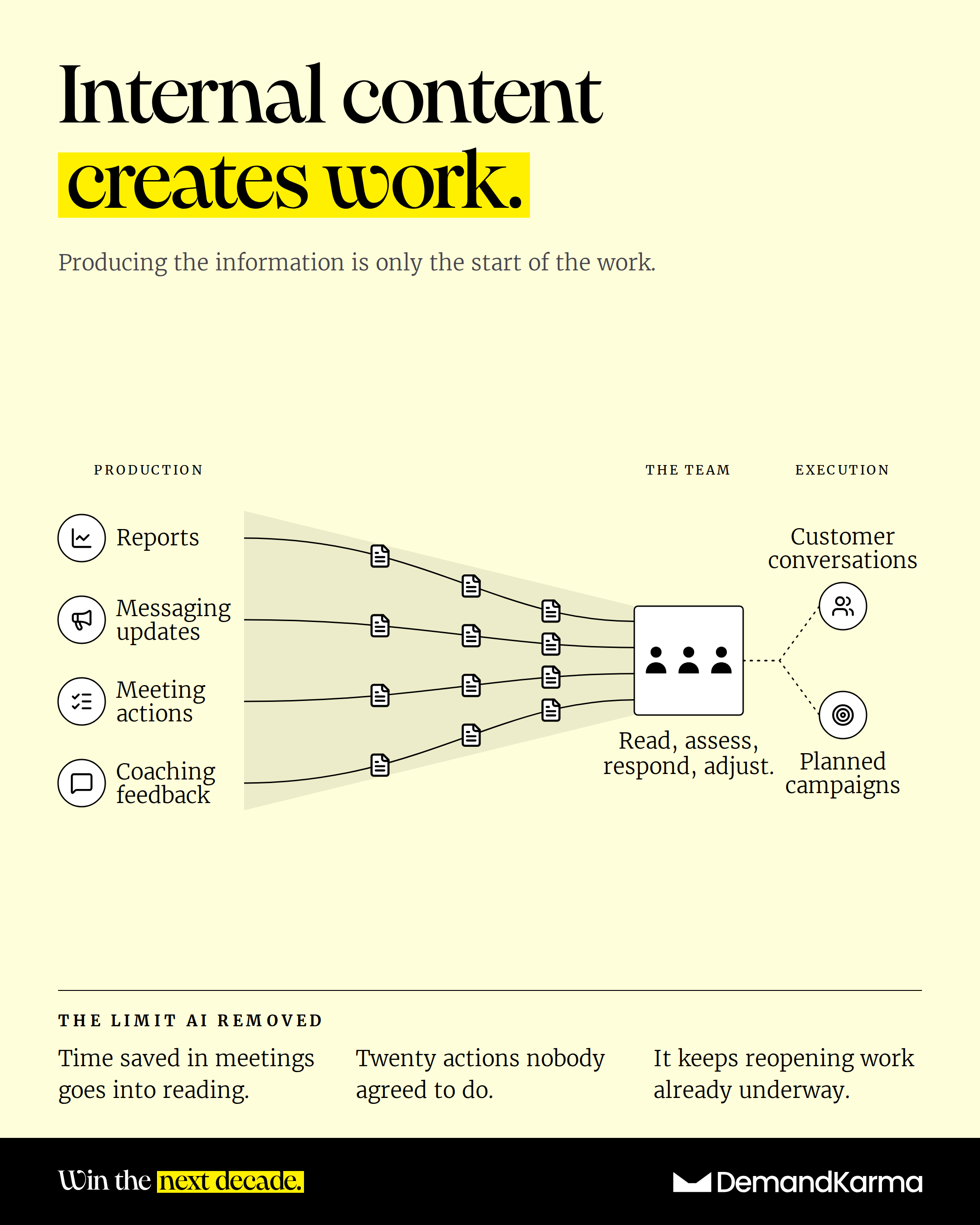
Marketing reports had become longer and sometimes weekly, even when little had changed. Messaging was being rewritten and recirculated every fortnight, sending Marketing back over content and emails instead of getting campaigns out. Reps received an AI coaching assessment after every customer call. Some were trying to adjust continually. You could hear the increasing self-consciousness replace the relaxed confidence. Meeting transcripts became long action lists, turning every suggestion into work nobody had agreed to prioritise.
Better reporting, current messaging and more coaching were all sensible things to want. But the team kept being asked to review, respond and adjust before it had executed what they were already working on.
The SaaS era fix that doesn’t work
The standard response to a team lacking time is to look at their calendars. Cut the meetings. Shorten the ones you keep. Send the material in advance. The calendar looks better, but people still have to do the reading and respond.
Moving updates to async can make the problem harder to see. AI makes it easy to produce more pre-reads, longer updates and more documents for people to review and comment on. Time saved in meetings goes into reading and responding. And a discussion that used to happen in one meeting can keep pulling people back between other pieces of work.
AI meeting notes add to this. A discussion produces suggestions, questions and possible next steps. The transcript becomes a list of twenty actions, even though nobody agreed to do most of them. Everyone leaves the same meeting with more work than they went in with.
Then people use AI to read, summarise and reply for them. They are following the mandate to start with AI. But getting through the updates more quickly doesn’t mean they understand enough to do the work well. A summary can tell someone what they have been asked to do while leaving out the reasoning they need to make a good decision. You still need an informed human in the loop.
The effort required to produce reports, update messaging and review calls previously limited how often those things happened. AI removed much of that limit. The recipients still need time to use what is being sent.
The leadership decision is how often new information should become a new instruction.
The execution test that does
There are always more ideas than the team can execute. Leading GTM, you need to help people get the work done. I want the team spending as much time as possible with customers and prospects. After that, on the work those people will see or use. Campaigns, content, proposals. It is easy for internal work to take more of the week as a company grows.
Apply an execution test before adding to it:
Is this worth interrupting the work we have already agreed?
The person sharing the information owns the demand it puts on everyone else. They need to decide what people need to know, who needs it and how often. And whether it should change the work already agreed.
You can usually spot an expensive meeting. Lots of people, too much time, little coming out of it. Apply the same discipline to internal content. Agree its purpose, what it needs to cover, who receives it and how often. Make the owner responsible for it being a good use of everyone else’s time. A report that was useful when you introduced it doesn’t automatically deserve to keep going out every week.
Agree how the team will work, and hold people to it. Ask what you made people redo this month, and whether it was worth delaying the original work.
1. Make the sender finish the work
Set a maximum length and agree what each regular update needs to cover. Do the analysis for the people receiving it. Communicate a tight executive summary covering what is important, what it means and anything they need to do. Link to the supporting detail so they can go deeper if needed. Don’t send the raw data and a long AI analysis, then leave everyone else to ask AI which parts matter. The person sending the report should have done that thinking.
Review what comes back. Send it back for editing if it is too long, unclear or doesn’t tell people what they need to know. The owner needs to have read and checked it before sharing it. Being able to generate a detailed report every week is not a reason to circulate one.
If things are on track, say so. A regular report can usefully confirm that nothing needs to change. People shouldn’t have to read a full assessment every week to discover that. Match the length and frequency to what the recipients need, including how much has happened since the last update.
2. Protect agreed priorities
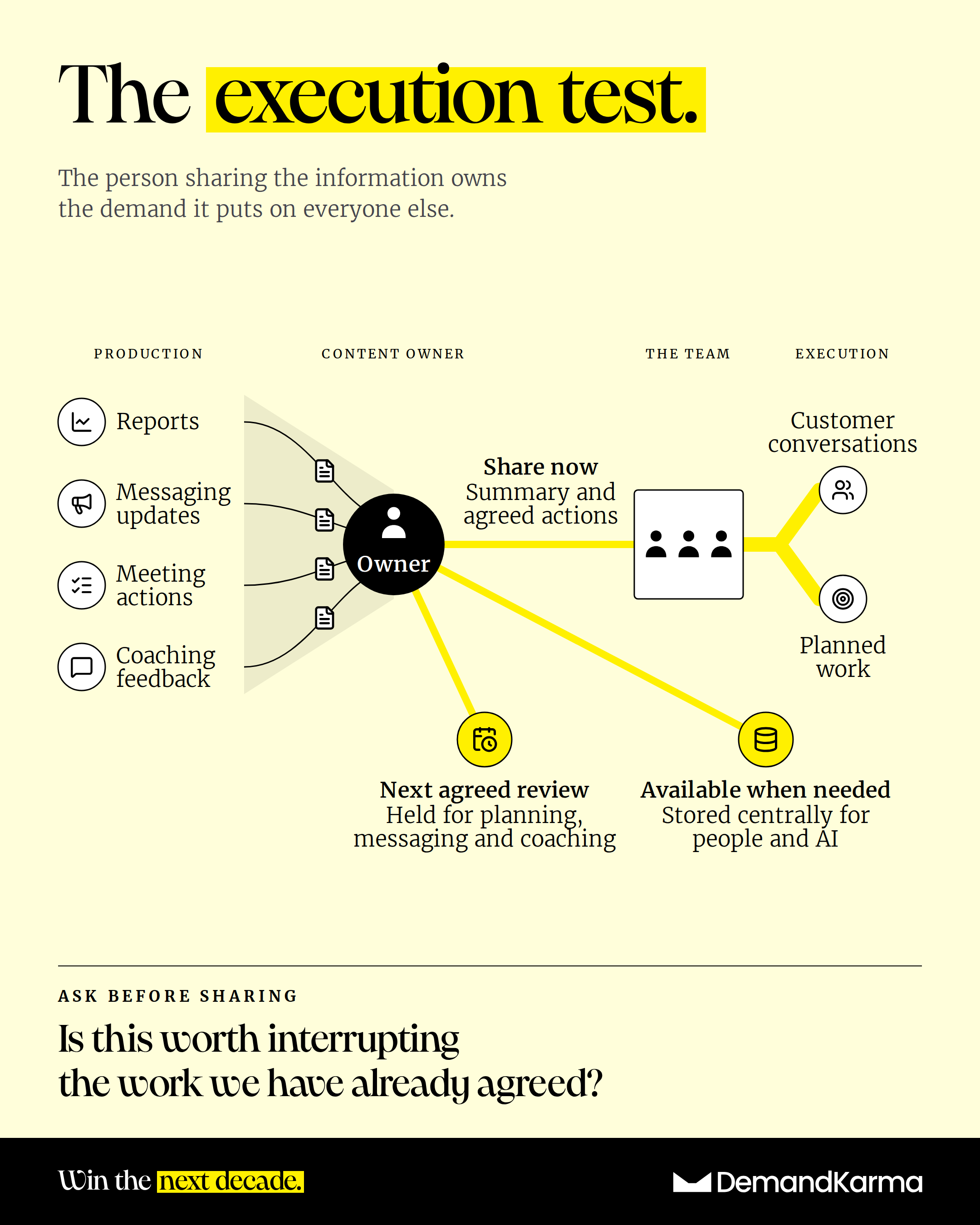
Decide who needs to act, who needs to stay informed and who only needs access for reference. Keep the full documents and supporting information centrally, where the team and its AI tools can find them when needed. That doesn’t require emailing everyone each time a document changes. Send people what they need to know. Say whether you need a response.
Apply this to your own ideas too. If you use Claude to assess a competitor’s campaign and suggest how your company could do something similar, think before sending the whole assessment to the team. They have to read it, work through how it applies and come back with a response. You may be trying to help. But an email from the CEO comes with work attached, whether you intended that or not. Collect those observations and bring them into monthly planning and prioritisation, unless something needs urgent attention. Assess the ideas alongside the work already being considered.
Give people permission to push back, leave a request until later or send it back if it disrupts agreed work. Expect common sense, and discuss those decisions in 1:1s. Ask what they left until later and why. Help them make better calls without bringing every request back to you for a decision. That permission needs to cover requests from senior people, including you. Otherwise it won’t protect much of their time.
3. Test changes before rolling them out
Test messaging changes with a small group before rolling them out to everyone. Put Product Marketing alongside a strong rep. Have an individual Sales rep or Customer Success Manager test a proposed change with customers. Use those conversations to work out whether the change improves the message enough to justify asking everyone else to use it.
Agree how often the wider team gets new messaging. Monthly at most is a useful starting point, with bigger changes grouped around product launches and major events. The small group can keep learning between those updates while Marketing finishes campaigns using the messaging already agreed. You don’t need the whole team to stop and reconsider its work every time someone learns something.
Before rolling out a change, look at what it will require people to redo. Is this change important enough to delay the campaign? Sometimes it will be. Make that decision knowing what it costs, rather than letting each update quietly send work back through another round of changes.
4. Give people time to improve
Bring AI call reviews together into a weekly coaching summary, alongside the rep’s usual end-of-week forecast update. Pick the three things they most need to improve, based on what matters most and how much improvement is needed. Have their manager review and adjust the priorities where needed. Then keep each one in place until the rep no longer needs to work on it.
The AI call review will keep finding things to comment on. That doesn’t mean the rep needs a different set of priorities every week. Continually asking someone to adjust can leave them thinking about everything they need to change while they should be listening to the customer.
They can be overcoached.
Use the call reviews to see whether they are getting better. Give them enough time to practise before deciding something else is more important. Has the rep had time to improve the last thing you asked them to change?
5. Agree the actions before the meeting ends
Use the last few minutes of every meeting to agree the important actions. What are we actually going to do? Who owns it, and by when? If an action changes the priorities already agreed, decide what will move to make room for it. Don’t leave that for everyone to work out afterwards.
A suggestion made during a discussion is not automatically a commitment. Some ideas need more thought. Others can wait. Be clear about which ones you are taking forward, and capture that agreement in the meeting so it is in the transcript.
Have AI produce the action list from those agreed decisions. The person running the meeting should check it before it goes out. Keep the full notes available for reference, but send people the commitments they actually made. If the meeting agreed three actions, the follow-up should contain three actions.
What life looks like after the fix
My latest session with the CRO was last week. A quarter on, the changes and using the execution test had worked.
The energy and focus had returned.
People were spending more time with customers, and the interactions were better.
More of the planned Marketing work was shipping.
He had changed how much internal information reached people, how often, and what they were expected to do with it.
Targets were still being hit, but this time it felt sustainable.
That conversation prompted me to write this article. These are growing pains I see as companies move to AI-first GTM. If you recognise them, you can address them. Better still, agree how your team will work before the volume starts getting in their way.
As a GTM leader, your job is to turn what AI makes possible into a way of working that helps the team execute. That requires decisions about what deserves their attention, when priorities should change and how much time people need to put an improvement into practice. The speed at which AI can produce another report, suggestion or assessment should not dictate how often you ask the team to change what they are doing.
CEOs and boards need to hold that line too. Set the expectation that AI helps the business deliver its plan, and judge progress by what reaches customers and prospects. Give people time to finish, learn and improve.
You cannot keep asking people to finish the plan while treating every new insight as a reason to change it.
This Week’s Tangible Prompt
Is AI giving your GTM team more time to execute?
Use this prompt to find where internal updates and requests are getting in the way of agreed work. Start with what you know about the last month. You don’t need to commission another report.
First, questions:
- Which internal reports, updates and AI-generated feedback does the GTM team receive? Who gets them, how often, and what are they expected to do?
- Which campaigns, sales activities or other planned work have been delayed or reopened? What prompted the change?
- Are the important actions agreed before each meeting ends, or created afterwards from the transcript? Who checks the list before it goes out?
- How often do messaging and coaching priorities change? Do people have time to use the messaging or improve before receiving another update?
- Can people defer or push back on requests, including those from the CEO? Is the supporting information available centrally without everyone being sent every update?
Then produce:
- The strongest evidence that internal information is disrupting execution. Separate what the examples show from what still needs checking.
- Up to three changes to make first. For each, specify what should change, who needs to agree it and which work it would protect.
- The information that should be shared now, held for the next agreed review or kept available for reference.
- What to check in a month to see whether more planned work is getting finished and the team has more time with customers and prospects.
Apply the execution test: is this worth interrupting the work we have already agreed?
Do not assume that shorter documents or fewer meetings will solve the problem. Look for unnecessary requests, repeated changes and suggestions being treated as commitments. Useful information can still arrive too often. A report confirming that things are on track can still be worth sending.
Do not recommend AI tools or invent missing information. Where the evidence is insufficient, ask the specific question needed to make the decision. Keep the response under 400 words.
That’s all for this week.
See you next Sunday.
Cheers,
Edwin & Josh
Reading is free. Waiting isn't.
If an essay hit a nerve, that nerve is usually worth an audit.
Book a callGet the essays before your competitors do.
New essays land here first. Free, weekly, unsubscribe whenever.